
GST Data Auditing & Error Detection System
Project Overview
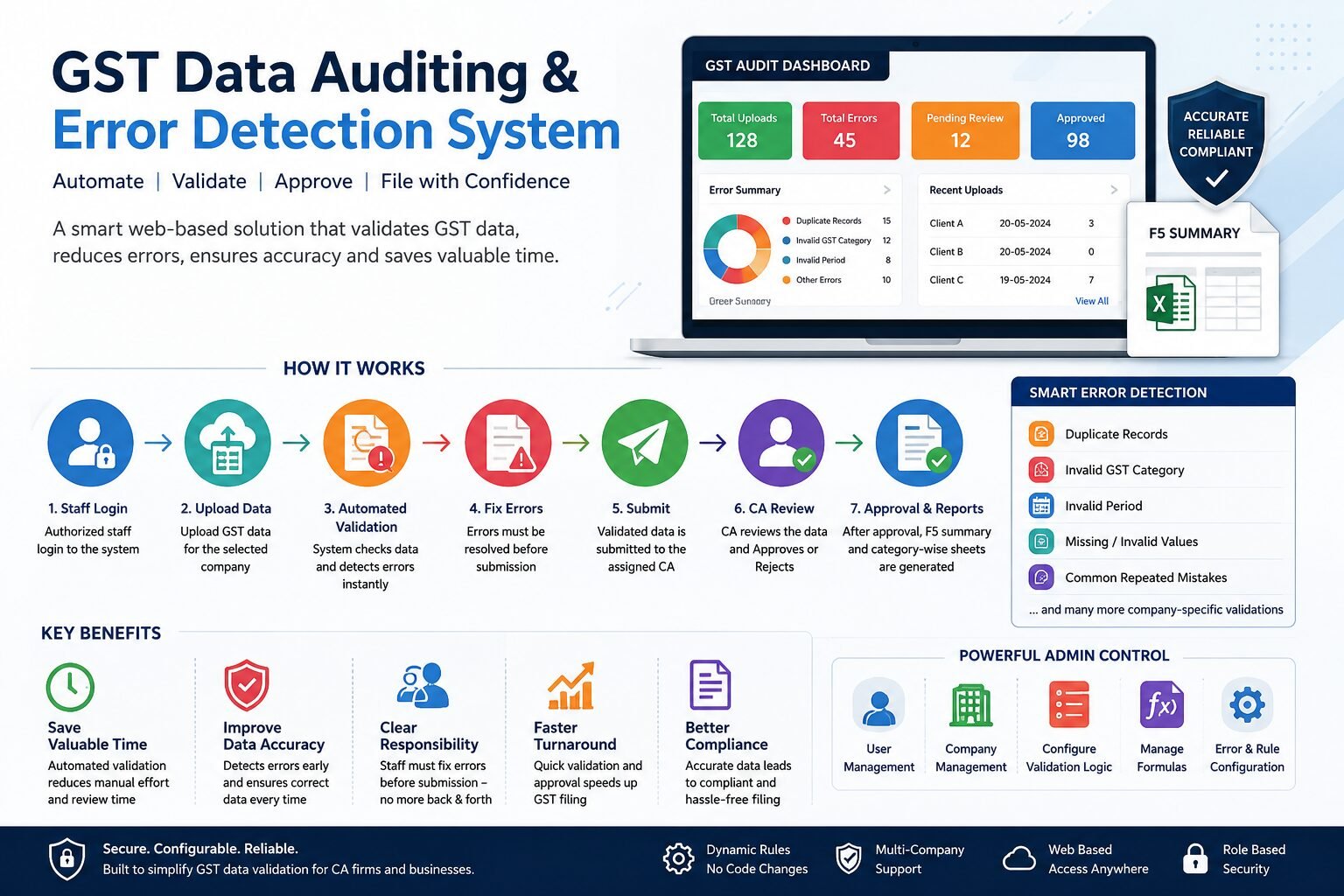
The GST Data Auditing & Error Detection System is a custom-built web application developed to streamline the GST data validation process for Chartered Accountant (CA) firms. The system automates the detection of common data errors before the data reaches the CA for final review, reducing manual effort and ensuring that only validated data enters the filing workflow.
The GST Data Auditing & Error Detection System is a custom-built web application developed to streamline the GST data validation process for Chartered Accountant (CA) firms. The system automates the detection of common data errors before the data reaches the CA for final review, reducing manual effort and ensuring that only validated data enters the filing workflow.
Unlike generic validation tools, this solution is fully configurable. Every company can have its own validation rules, formulas, and data structure without requiring code changes.
Business Challenge
During every GST filing cycle, CA firms receive transaction data from multiple clients. This data often arrives close to the filing deadline and contains various formatting and validation issues.
The traditional workflow involved:
- Staff manually reviewing uploaded data.
- Identifying errors one by one.
- Returning the file to the client for corrections.
- Waiting for the corrected file.
- Repeating the review process.
This cycle consumed valuable time and frequently delayed GST filing. Since responsibility for data quality was unclear, the same errors continued to occur across multiple submissions.
Solution
The GST Data Auditing & Error Detection System automates the complete validation process immediately after data upload.
Instead of manually checking spreadsheets, staff upload the data through the application. The system instantly scans the file against predefined business rules and displays every detected error.
Submission is blocked until all mandatory errors are resolved, ensuring that incomplete or invalid data cannot move to the next stage of the workflow.
Once the data passes all validations, it is submitted directly to the assigned Chartered Accountant for review and approval.
Workflow
Step 1 – Staff Login
Authorized staff members log in securely to the application.
Step 2 – Upload GST Data
The user uploads the GST data file for a selected company.
Step 3 – Automated Validation
The system immediately validates the uploaded data and detects issues such as:
- Duplicate records
- Invalid GST categories
- Invalid return periods
- Incorrect field values
- Missing mandatory information
- Company-specific validation failures
- Frequently occurring business mistakes
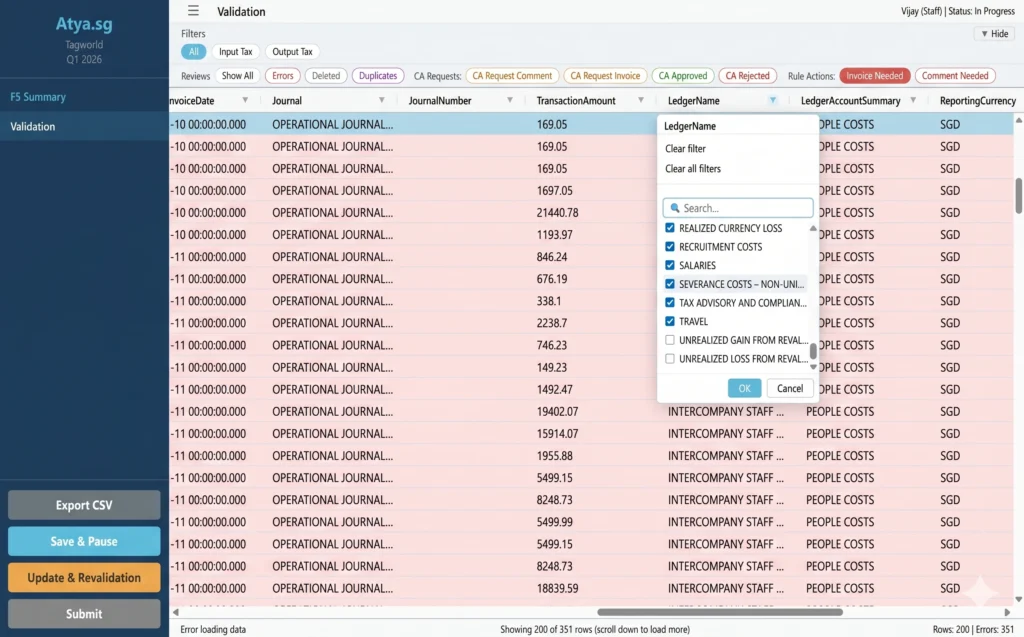
Errors are displayed instantly with detailed descriptions.
Step 4 – Error Resolution
The uploaded data cannot be submitted until all mandatory validation errors are corrected.
This process:
- Improves accountability
- Assigns responsibility to the data preparation team
- Eliminates repeated review cycles
- Ensures cleaner data before CA review
Step 5 – Submit for Review
After successful validation, the staff submits the data.
The application automatically routes the submission to the assigned Chartered Accountant.
Step 6 – CA Review
The Chartered Accountant reviews the validated data through a dedicated dashboard.
The CA can:
- Review validation results
- Approve the submission
- Reject the submission with comments for correction
Step 7 – Report Generation
Once approved, the system generates:
- F5 Summary Report
- Category-wise data sheets
- Structured outputs for further GST filing activities
Dynamic Validation Engine
One of the core strengths of the system is its dynamic validation engine.
Validation rules are not hardcoded into the application.
Instead, administrators can configure:
- Validation logic
- Error descriptions
- Business rules
- Formula definitions
- Company-specific conditions
This enables the same application to support multiple companies with completely different data structures and validation requirements.
Whenever a company’s business rules change, administrators can update the configuration without modifying the application’s source code.
Administration Module
The Admin Dashboard provides complete control over the application.
Administrators can:
- Create and manage users
- Register companies
- Assign users to companies
- Configure company-specific validation logic
- Modify formulas
- Manage error definitions
- Update validation rules dynamically
This flexibility makes the platform highly adaptable to changing GST and business requirements.
Key Features
- Automated GST data validation
- Real-time error detection
- Duplicate record identification
- Invalid GST category detection
- Invalid filing period validation
- Company-specific business rule validation
- Dynamic rule configuration
- Configurable error messages
- Multi-company support
- Role-based access control
- Staff and CA approval workflow
- Dashboard-based review process
- F5 Summary generation
- Category-wise report generation
- No-code validation rule management
Business Impact
The implementation of this solution significantly improved the GST filing workflow by:
- Reducing manual data verification effort
- Detecting errors immediately after upload
- Preventing invalid data from entering the approval process
- Increasing accountability among staff members
- Reducing repeated correction cycles
- Helping CA firms review validated data instead of searching for errors
- Improving turnaround time during GST filing periods
- Supporting multiple companies with unique validation requirements through a single configurable platform
Technology Highlights
- Web-based application
- Role-based authentication
- Dynamic validation engine
- Configurable business rules
- Workflow-driven approval process
- Multi-company architecture
- Dashboard-based reporting
- Scalable and maintainable system design